


Teacher Training Program
Train in the original classical method under a Level IV Teacher Trainer at Contrology Studio. Romana’s Pilates International® is a rigorous apprenticeship program (600+ hours) designed to create true teachers of the method, not weekend-certified instructors.
Become a Romana’s Pilates™ instructor
Led by Level IV Romana’s Pilates International™ Teacher Trainer — Miquel Banket
Contrology Studio is proud to be a training home for Romana’s Pilates International® (RPI), the world’s most respected and authentic classical Pilates certification. As one of the select Level IV Teacher Trainers, Miquel Banket brings deep lineage, mentorship, and hands-on expertise to every apprentice training at the studio.
All seminars and testing will take place in Los Angeles or Portland under the expert guidance of Level X Teacher Trainers. Apprentices will immerse themselves fully in the classical system, learning to teach with precision, integrity, and unwavering respect for Joseph Pilates’ original work.
Romana’s Pilates Teacher Trainers are handpicked, guided, and mentored directly by Level I Master Teachers: Sari Mejia Santo, Daria Pace, Juanita Lopez, and Cynthia Lochard.This selective lineage ensures the highest standards of teaching, the continuation of classical Pilates as Romana intended, and the development of instructors truly prepared for a lifetime of teaching. This is not a mat-only certification. Apprentices must demonstrate both performance mastery and teaching competency across all major Pilates apparatus—Reformer, Mat, Cadillac, Chairs, Barrels, and auxiliary equipment.
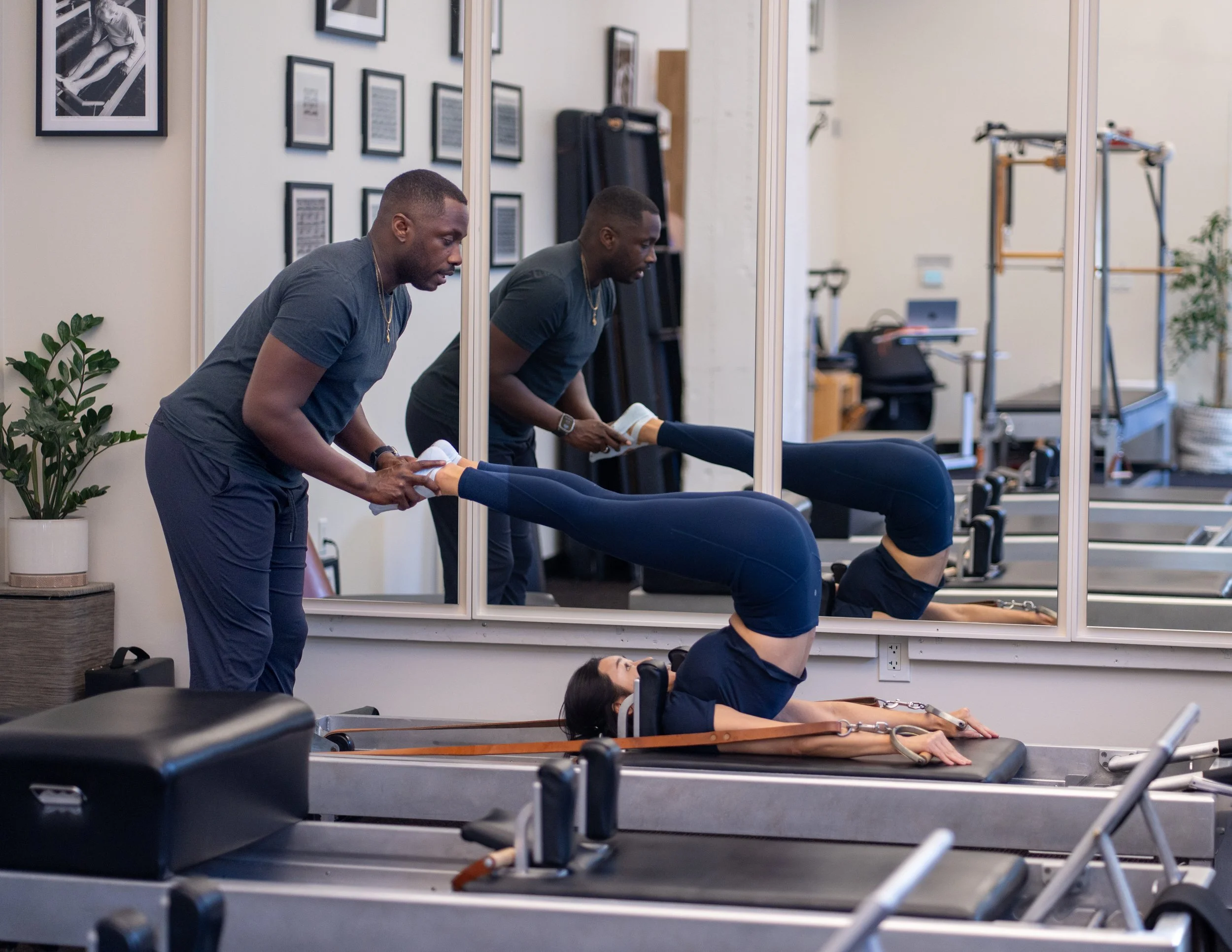
Certification Process
-
Before entering the teacher training program, apprentices must demonstrate consistent proficiency at the Intermediate to Advanced level within their own Pilates practice.
This means more than simply recognizing the exercises. Applicants should move confidently through the intermediate system on all major apparatus — including the Reformer, Cadillac, Wunda Chair, High Chair, Ladder Barrel, and Mat — with proper setup, transitions, spring changes, and control.
A qualified apprentice is able to:
Execute exercises with strength, stability, and precision
Maintain flow and continuity throughout a full intermediate workout
Demonstrate clear understanding of spring settings and equipment setup
Apply the Six Principles of Pilates — Concentration, Control, Centering, Precision, Flow, and Breath, —consistently in their own body
Teacher training is not where you learn the exercises for the first time. It is where you refine your understanding, deepen your discipline, and learn how to teach the system with clarity and responsibility.
-
All prospective apprentices must complete a formal assessment prior to acceptance into the program.
The assessment is designed to ensure that each applicant possesses the physical proficiency, technical understanding, and foundational discipline required to enter a classical teacher training program. This is not a pass-through step — it protects the integrity of the work and sets every apprentice up for success.
During the assessment, applicants will be evaluated on:
Execution of a full intermediate workout on key apparatus
Proper equipment setup and accurate spring settings
Smooth, controlled transitions between exercises
Strength, stamina, and body awareness
Understanding and embodiment of the Six Principles of Pilates
Ability to respond to correction and apply feedback immediately
Applicants must demonstrate consistent control, flow, and precision throughout their practice. The goal is not perfection — it is readiness.
Teacher training builds teachers. It does not build foundational practitioners. The assessment ensures that apprentices enter the program prepared to study, refine, and ultimately lead others through the classical system with clarity and confidence.
-
The teacher training program is divided into three progressive sections: Basic, Intermediate, and Advanced. Each level builds intentionally upon the one before it, creating a comprehensive and systematic understanding of the classical Pilates method as preserved through the Romana’s Pilates lineage.
Each section begins with an in-depth seminar held in Los Angeles. During these seminars, apprentices study the full system of exercises appropriate to that level across all major apparatus — including Mat, Reformer, Cadillac, Chairs, Barrels, and auxiliary equipment.
Apprentices do not simply learn the exercises. They are trained to understand:
Proper setup and accurate spring settings
Order, transitions, and workout flow
Teaching language and hands-on corrections
Modifications and progressions
The Romana’s Pilates standard for safely introducing, advancing, and challenging a client within the system
Romana’s methodology emphasizes progression with purpose. Apprentices are taught when to introduce new material, when to hold a client back, and how to advance safely while preserving the integrity of the work.
-
Following each seminar, apprentices return to the studio to complete a minimum of 200 apprenticeship hours before advancing to the next level. These hours include supervised teaching, observation, assisting senior instructors, structured study, and consistent personal practice.
This program is rooted in learning by doing.
Apprentices are not passive observers. They refine their understanding through repetition, correction, real-time teaching experience, and accountability. Teaching is developed through practice — not through sitting and watching.
Between seminars, apprentices participate in weekly meetings designed to prepare them for examination and deepen their comprehension of the system. These meetings include:
Technical breakdown of exercises
Equipment setup accuracy and spring precision
Transition training and flow refinement
Practice teaching scenarios
Oral review and system-based questioning
Application of the Six Principles in both practice and instruction
Apprentices are expected to study independently and come prepared with thoughtful questions. Mastery is built through discipline, dialogue, and refinement.
Testing & Advancement
At the completion of each section, apprentices must pass a formal examination before progressing. Testing includes practical performance, teaching demonstration, and oral questioning to assess technical accuracy, system knowledge, progression standards, and the ability to apply the classical method responsibly.
Advancement is earned — not assumed.
Each level must be successfully completed before moving forward. This structure ensures that graduates of the program meet the Romana’s Pilates standard and are prepared to teach with confidence, clarity, and respect for the original work.